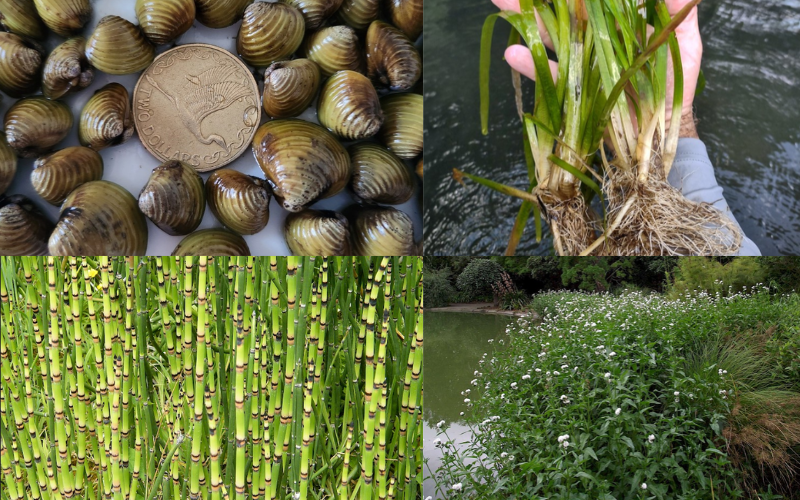
This month’s pest spotlight highlights four key species that threaten Marlborough’s environment and economy: gold clams, Rough horsetail, Eelgrass, and Senegal tea. Early detection and reporting remain our best defence—your vigilance matters.
These invasive species can form dense populations that smother and outcompete native species, reduce biodiversity, degrade water quality, and disrupt waterway health and use.
Gold clam: threatens our native species and water quality
Gold clams are invasive freshwater shellfish that live in rivers, lakes and reservoirs, particularly in sandy or muddy substrates. Their triangular shells range from dark brown to dull gold. They reproduce rapidly, with one mature clam producing up to 70,000 juveniles a year, allowing dense populations to establish and compete with native species such as kākahi and other New Zealand freshwater mussels. Large infestations can also clog water infrastructure and alter water quality by removing nutrients such as calcium, increasing water-treatment risks. Although gold clams have not been reported in Marlborough or elsewhere in the South Island, they have caused problems in Waikato and Taranaki. They spread mainly through boating and the movement of contaminated recreational equipment, so check, clean and dry all gear between waterways and report any suspected sightings early.
Rough horsetail: smothers native plants and reduces wetland biodiversity
Rough horsetail is a primitive, colony-forming fern ally that looks like a strange asparagus spear with distinctive black collars at each joint. It thrives in swampy areas, where dense colonies can smother native plants, reduce wetland biodiversity, and degrade wildlife habitat. Its extensive underground network lets it resprout easily, making infestations hard to control and increasing the risk of long-term damage. Although management has reduced it to five known sites near Renwick, Northbank and Okaramio, mainly in managed gardens, Marlborough’s wetlands remain vulnerable. Residents are our eyes—if you see rough horsetail in your garden or local wetlands, please notify the Biosecurity Team.
Eelgrass: chokes waterways and outcompetes native aquatic plants
This submerged aquatic plant features ribbon-like leaves up to three metres long. It can form dense underwater growth that chokes waterways, displaces native aquatic plants and affects the health and use of freshwater habitats. Eel grass spreads by fragments, rhizomes and runners, often accelerated by human activity such as contaminated machinery or dumped aquarium plants. Over 20 years, a major management programme removed more than 30 tonnes from the Ōpaoa River and Waterlea Creek. A new infestation could undo this progress and require another significant control effort, so please report any suspected eelgrass in local waterways.
Senegal tea: blankets waterways and degrades aquatic habitats
Senegal tea forms dense mats in shallow water and on damp ground, blanketing waterways and crowding out native vegetation. These mats can degrade aquatic habitat, impede water flow and disrupt swimming, boating and other recreational activities. The plant is well-suited to Marlborough’s climate and can spread via floating stems and long-lived seeds. Although it has been eradicated from managed gardens locally and there are no current infestations, it could return and rapidly establish if not detected early. Report any sightings, especially near water, to the Biosecurity Team.
What You Can Do
• Learn to identify this month’s pests
• Report sightings to the Council’s Biosecurity Team (03 520 7400 or biosecurity@marlborough.govt.nz)
• Avoid moving plant material or aquatic fragments between sites
• For more information, visit: Weedbusters • Working together to protect Aotearoa New Zealand