

Working together to slow the flow
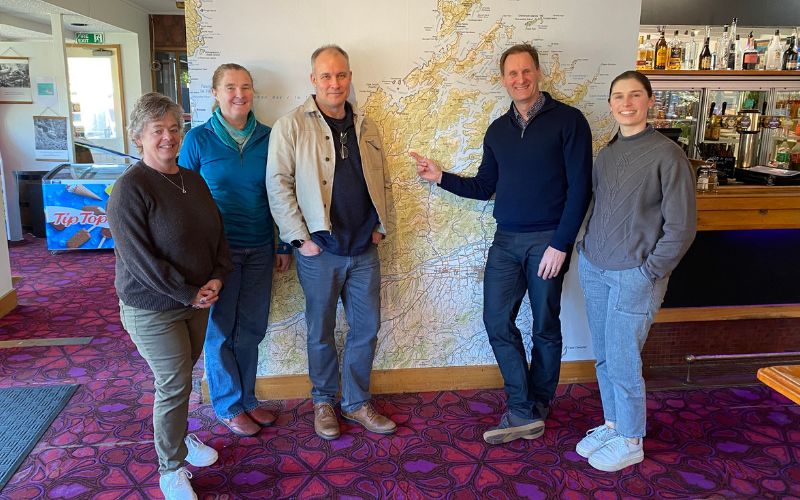
NBS team members from left to right, Council’s Anne Bruce; Heather Collins (Heather Collins Consulting); Jon Tunnicliffe (Associate Professor, Fluvial geomorphology, University of Auckland); Council Senior Environmental Scientist Matt Oliver and Council Hydrologist Charlotte Tomlinson
It’s not possible to stop flood waters, but it is possible to slow them down.
This was a key takeaway for farmers, landowners and rural professionals at two ‘Slowing the Floodwave’ interactive workshops held at Okaramio and Rai Valley.
Run as part of the Nature-Based Solutions (NBS) project, led by Council with funding from the Ministry for the Environment, the workshops focused on modelling how possible solutions can be applied in steep catchments prone to flooding. Twenty-one projects across 15 regions participated, and the Te Hoiere/Pelorus catchment was chosen as the study area.
Matt Oliver, Senior Environmental Scientist - Land, said the workshops informed the catchment community about the NBS project, shared modelling results and sought feedback from stakeholders about workable solutions. Project-lead Jon Tunnicliffe from the University of Auckland delivered the presentation.
Computer modelling highlighted practical options to slow and temporarily store water during adverse weather events.
“Nature-based flood management can reduce flood peaks and erosion. The workshops provided a good opportunity to understand how some solutions might work in specific catchments,” Mr Oliver said.
“Nature-based solutions can have a more significant impact on smaller, more regular floods rather than on the more extreme events, but they can help to build resilience within a catchment for when the big ones arrive.
“Slowing floodwaters does not always require heavy engineering. Small, strategic interventions over time, such as riparian and headwater planting or structures to reduce peak flow, can make a significant cumulative impact. It is all about measures to slow, store and delay - and everyone can contribute to that.”
The workshops provided a chance to share valuable research results, including data gathered from water sensors located throughout the Te Hoiere and Kaituna catchments. These sensors capture real-time data during flood events, forming a reliable foundation for building accurate flood models, Mr Oliver said.
“Using these models, Jon and the University of Auckland team explored how implementing nature-based solutions could affect water flow during flood conditions. We have tried to illustrate this work to landowners and farmers to help them visualise potential outcomes on their own properties and collectively, on downstream flood levels.”
Find more information on the Nature Based Solutions to Flooding for Te Hoiere storymaps

