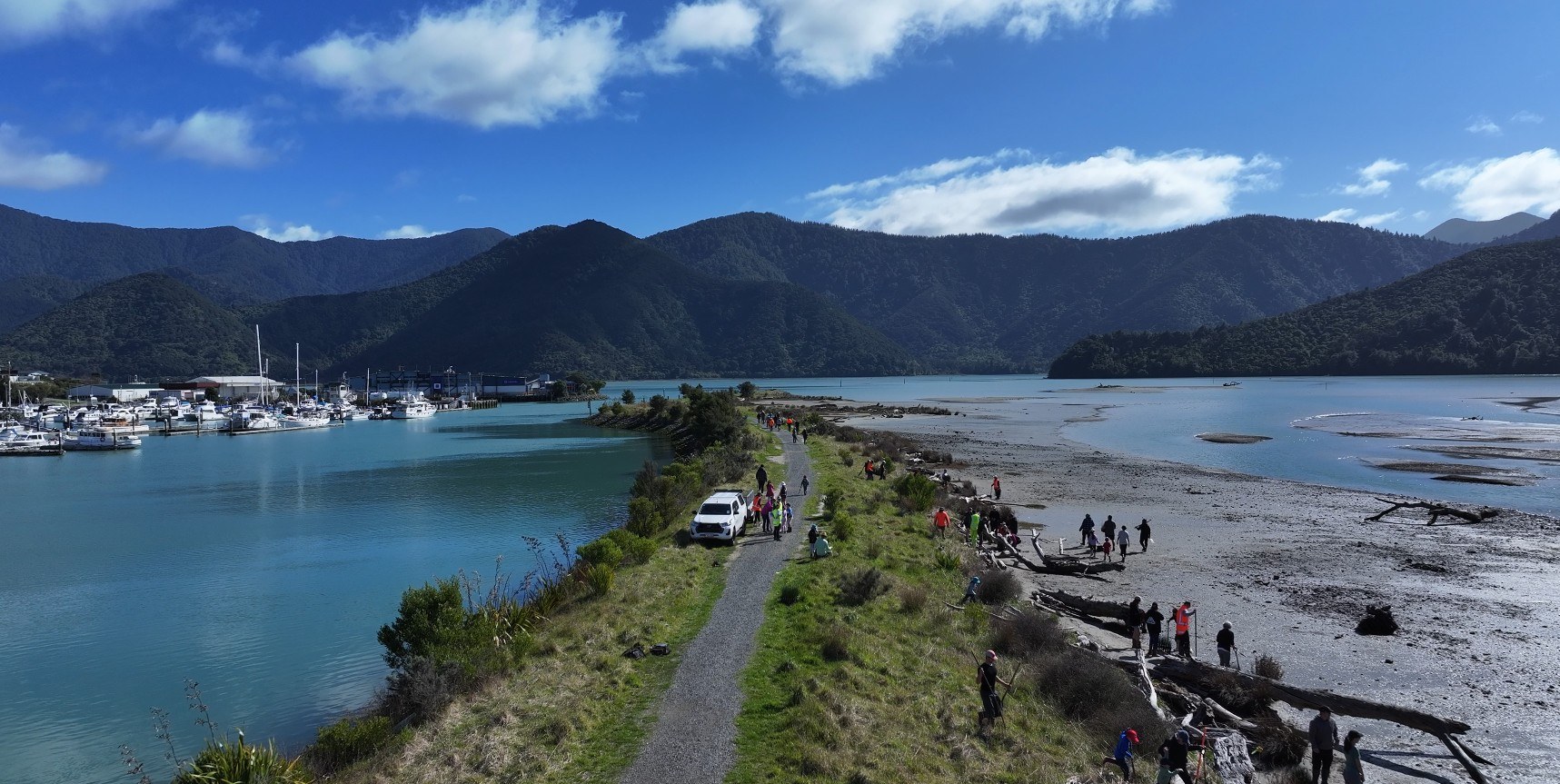
A community-led restoration plan for the Motuweka Havelock Estuary, funded through Te Hoiere Project, has been finalised.
The plan prioritises restoration activities into immediate, medium and long-term actions ranging from low-cost planting projects to more involved, coordinated responses to sea level rise.
The community has made significant progress in improving freshwater quality through improved land management, Te Hoiere Programme Manager Rachel Russell said.
“The biggest impact on the estuary is sediment, which comes from human and natural activities from all the sub-catchments. That has been our focus.”
The new plan is the first to look at restoring the catchment’s receiving environment, with a detailed roadmap. Planning began in 2024, when Solucom and Salt Ecology were engaged to work alongside the community to identify the main issues, guided by cultural, social, economic and ecological values.
The first stage was a collaboration involving Ngāti Kuia, Rangitāne o Wairau, Department of Conservation, Marlborough Marine Farm Association, Port Marlborough, Council and the Havelock community.
People created this problem and were the ones to restore it, Matt Hippolite of Solucom said.
“When people restore nature, they restore themselves at the same time. Ecological restoration is a great focal point to restore social connections,” he said.
Salt Ecology’s Leigh Stevens has monitored the estuary’s health for 20 years, looking at seagrass, salt marsh habitat and intertidal flats
“The estuary has been muddy for 150 years since the first clearing of the hillsides. The change in habitats changed what lives here, with more Pacific oyster beds and less valuable seagrass,” he said.
Seagrass is a positive indicator of estuary health. Since 2014, 21 hectares of seagrass has been lost in Motuweka/Havelock and in 2024, only 1.1 hectares remained.
Improving estuary health involves a multi-pronged approach and will take time.
“It’s having all of the ecological parts functioning well, alongside a community that understands and helps to protect its resilience. Success is clear waters, increasing bird and marine life, and the eventual restoration of lowland coastal forest,” Mr Stevens said.
The full report and estuary plan, including planting guidance for the community, can be found at Tehoiere website.