

Wildfire in our Parks and Open Spaces


Wildfire Season: What you need to know
During summer, wildfire risk can change rapidly across Marlborough’s parks and reserves. To help keep visitors safe, Marlborough District Council monitors fire conditions using NIWA fire weather data, local weather forecasts and on-the-ground assessments.
When fire danger increases, Council works closely with Fire and Emergency New Zealand (FENZ) to assess risks and determine whether restrictions or park closures are required.
Before visiting a park or reserve, always check the current fire danger rating and any access restrictions. Conditions can change quickly during periods of hot, dry weather.

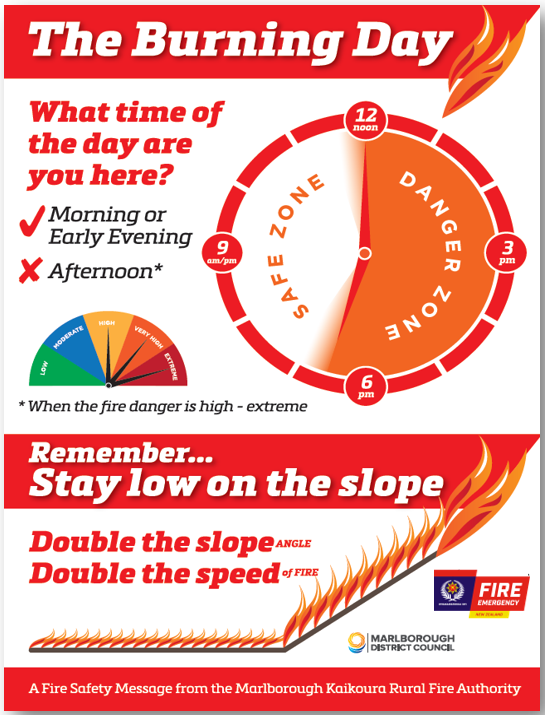
Staying safe in our parks
Help reduce wildfire risk and keep yourself safe by following these simple precautions:
- Carry a mobile phone and call 111 immediately if you see a fire
- Check park access restrictions and permitted activities before your visit
- Avoid smoking or vaping in parks at all times
- Visit earlier in the day or in the evening when temperatures are cooler
- Know your location and identify your nearest exit before heading further into the park
- Stay alert to changing weather conditions, particularly strong winds
- Leave the area immediately if you see signs of fire
- If a park is closed, do not enter. Closures are in place for your safety and to support emergency response efforts
Wildfire Season: Frequently Asked Questions
What is the fire danger rating system?
Marlborough District Council uses a colour-coded fire danger rating system that ranges from Low through to Extreme. Each level may have different restrictions on park access and activities to help reduce wildfire risk.
Details regarding current fire danger levels can be found online. Fire restrictions are communicated through online channels and signage at park entrances.
Why are there fire restrictions during summer?
Hot, dry conditions combined with increased vegetation growth can significantly increase the risk of wildfire. Fires can spread rapidly, and in remote areas escape may be difficult or impossible. Fire restrictions help protect visitors, neighbouring properties, park infrastructure, and the natural environment.
Many restoration areas contain young native plantings that are particularly vulnerable to fire damage.
How will I know if restrictions are in place?
Information about closures and restrictions is available:
- On individual park pages on this website.
- On signage at park entrances.
- Through Council social media channels.
- Via Council updates during periods of elevated fire danger.
Always check conditions before travelling to a park, particularly during summer.
How do you determine fire danger levels?
Fire danger assessments are based on several sources of information, including:
- NIWA Fire Weather Indices.
- Weather forecasts.
- Local site inspections.
- Temperature and humidity levels.
- Vegetation and grass dryness.
- Wind conditions.
- Recent and forecast rainfall.
When conditions reach predefined trigger levels, Council reviews the likely fire behaviour and forecast weather and in conjunction with FENZ, decides whether restrictions or closures are required.
Why is the park still closed after rain?
Rain does not immediately remove wildfire risk.
Dry grass and vegetation need time to break down, while new green growth must become established before fuel loads reduce significantly. Depending on conditions, this process can take several weeks.
Strong winds and warm temperatures can also dry vegetation quickly after rainfall, causing fire risk to remain elevated.
Why can contractors, utility companies and park staff enter closed parks?
As a general rule, when a park is closed, access is not permitted. In exceptional circumstances, contractors or staff may be granted access to undertake urgent works, such as addressing significant health and safety hazards or responding to critical risks affecting infrastructure or essential utilities.
Council knows where authorised workers are operating and can communicate with them directly if conditions change or evacuation is required.
Public visitors do not operate under these controls, which makes it much more difficult to coordinate emergency communication and evacuation during a wildfire event.
Are fires allowed in Council parks and reserves?
No. Open fires are generally prohibited in Marlborough District Council parks and reserves.
Any exceptions must be specifically approved by Council or occur within designated facilities where permitted.
Are there restrictions on vehicles, motorbikes and e-bikes?
Yes. Some parks may restrict vehicle access during periods of elevated fire danger.
Where vehicle access is permitted:
- Do not park on dry grass or vegetation.
- Four-wheel-drive vehicles may be required to carry firefighting equipment.
- E-bikes should be maintained in accordance with manufacturer recommendations.
- Do not operate damaged e-bikes or modified electrical systems.
Can I bring fireworks into parks?
No. Fireworks are prohibited year-round in Council parks, reserves and public places because of the fire risk they create.
Where can I find more information?
For the latest information about park access, restrictions and fire danger:
- Check the relevant park pages on this website.
- Look for notices at park entrances.
- Review current fire danger information.
- Contact Marlborough District Council if you are unsure whether an activity is permitted.
- Fire and Emergency New Zealand website.
Before you visit, always check the latest conditions. A few moments spent checking can help protect people, property and Marlborough’s natural environment.

